Private previewHarcourts Tasmania

What's possible with AI. Our journey so far.

A short walkthrough of what we are building with AI, and a framework to find your own first automation. Enter your details to view it.

Presented by Brad Reeves. By providing your details you agree to receive further material from Brooklyn Bradley.

Reeves
Reeves
Left / right to navigate  ·  F fullscreen
Harcourts TasmaniaBusiness owners

What's possible with AI. Our journey so far.

Presented byBrad Reeves
Session45 minutes, live walkthrough
OverviewWhat we'll cover

Four parts, forty-five minutes.

  • Part one
    A quick recap on AIThe four levels, so wherever you sit with this today, you can place yourself.
  • Part two
    My philosophyHow we actually use it, and why no one on the team has had to learn to build.
  • Part three
    What we've builtFour areas, running today: personal, business, property management and sales.
  • Part four
    How to startA simple test to find the one task in your business worth handing over first.
Part one
A quick recap on AI.

Four levels. Wherever you sit with this today, you can place yourself, and see where the time you get back really comes from.

The ladder

Four levels of AI.

Most people only ever meet level one. The time you get back compounds as you move down the ladder, and everything we are building lives at levels three and four.

Select a level
Part two
My philosophy.

A handful of principles that shape everything we build, and why no one on the team has had to become an AI person.

My philosophyWhy use AI

Why use AI?

The hype says AI will replace us, our jobs, our businesses. Maybe it will. I would rather treat it as an existential threat and get ahead of it than bet everything we have built that it won't. So I keep it practical. It comes down to two questions.

The what

Create efficiency and revenue. Cut waste, time and cost on one side, add revenue on the other. Both feed the same number: profitability.

The how

Improve the client experience. The human element is what people will crave, so we automate the work that never touches a client and give our people the time and data for the work that does.

My philosophyHow this actually works

I don't write code. I describe what I want.

Everything you're about to see, we built with Claude Code, and I've never written a line of it. I brief it in plain English, the same way I'd brief a person. It writes the code.

Every weekday at 8:30, open MYOB, match the bank transactions against these rules, code them, and tell me anything you're not sure about. That is the whole instruction. No syntax, no training course.

If you can explain a process clearly enough for a new hire to follow it, you can build it. The hard part was never the code. It is knowing your business well enough to describe it.

0Lines of code written
My philosophyHow this actually works

I've never asked the team to go learn AI.

That is deliberate. Instead, we build the tool, and they use it inside the workflow they already have.

The commercial angle

Everything we build sits inside a separate business. If it is valuable to us it is valuable to someone else, so anything of real substance gets commercialised.

Why build, not train
  • Guardrails. The tool defines what is expected, so the output is consistent.
  • Data safety. Nothing sensitive gets pasted into random tools.
  • Adoption. Nobody has to become an AI person to get the benefit.
  • Focus. The team stays on their job, not on learning software.
My philosophyHow this actually works

You don't need to be the AI expert.

But you do have to be the driving force behind it. The business of today needs just one person who is genuinely expert in AI and how to implement it, not a whole team of them. Your edge is knowing how the business runs, and it only happens if you make it a priority and push it through.

YouThe process expert, and the driving force
+
An AI expertKnows what is possible, and how
=
Real efficiencyGains neither of you get alone
And we are not ripping anything out

VaultRE, PropertyTree, Xero and MYOB all stay. We are not replacing software. We are closing the gaps between it, and dropping Claude in to do the step a person used to do.

Part three
What we've built.

Four areas we have implemented across both businesses: personal, back office, property management and sales.

What we've built01 Personal

Start with your own desk.

The fastest way to understand what is possible is to hand over your own admin first. Ask one question of every task you do: how can AI do this for me?

Daily brief

Calendar, priorities and overnight email read and summarised before I am at my desk.

Email triage agent

Every email read and categorised, invoices routed to the books, and a short list of what actually needs me.

Wispr Flow

Speak instead of type. You talk around three times faster than you type, so briefs, emails and prompts get dictated in a fraction of the time.

Recruitment

Applicants screened and shortlisted, then a private, personalised offer page built for the exact person you want to land.
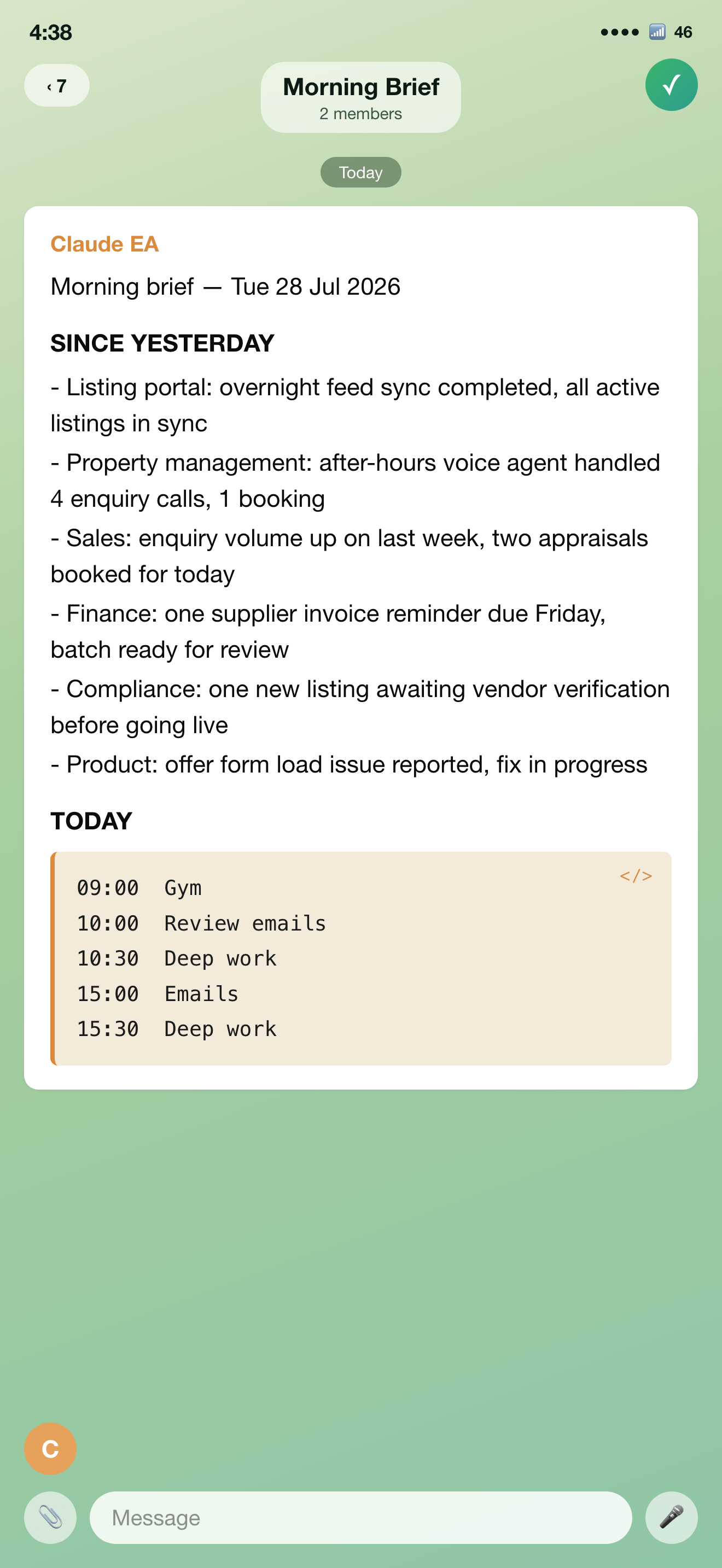
7amBrief ready
5 hrsSaved per week
3xSpeaking vs typing
Claude EA morning brief, shown in Telegram

This is the work an EA or a VA would do. That is the point. Replace the EA with Claude.

What we've built02 Business

The books, reconciled overnight.

The back office is the easiest place to prove the value, because the rules are already written down. This is the job every owner hates and every bookkeeper charges for.

AI bookkeeper

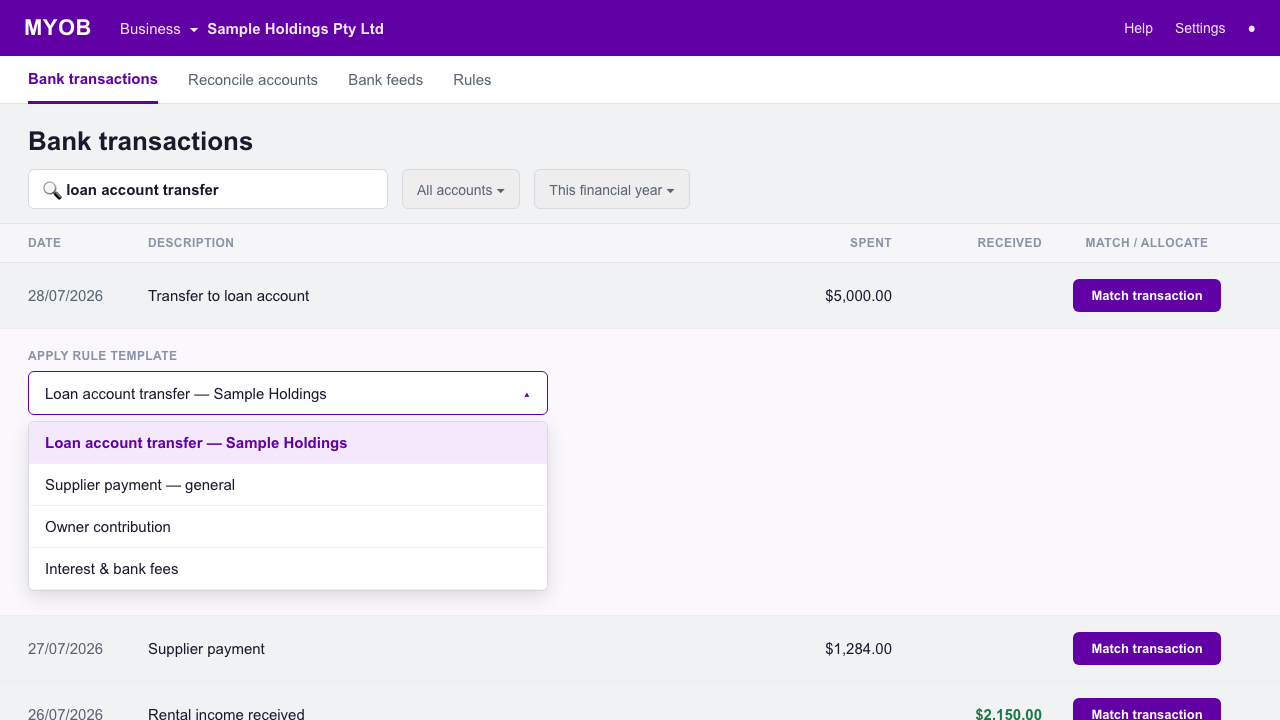
Accounts and emails read, categorised and shipped straight to the accounting software. Bank transactions matched and coded in Xero and MYOB: cleaning invoices, loan interest, rental income, GST refunds.

Runs on a schedule

Across multiple entities, every weekday morning, before anyone is at a desk.
8+Entities automated
8:30amMonday to Friday
MYOB bank transactions, applying a reconciliation rule template
What we've built03 Property management

Meet Penny.

Property management is phone calls and repeatable process, and both are now automatable. Penny is an AI voice agent that runs our storage facilities without ringing the team.

Penny AI

Answers every enquiry call, quotes and books units, chases arrears and calls the waitlist back. Day or night.

Leasing process flow

The application to ingoing steps closed up end to end, so nothing sits waiting on a person.

Voice agents

Inbound and outbound calls handled, with only genuine exceptions reaching the team.
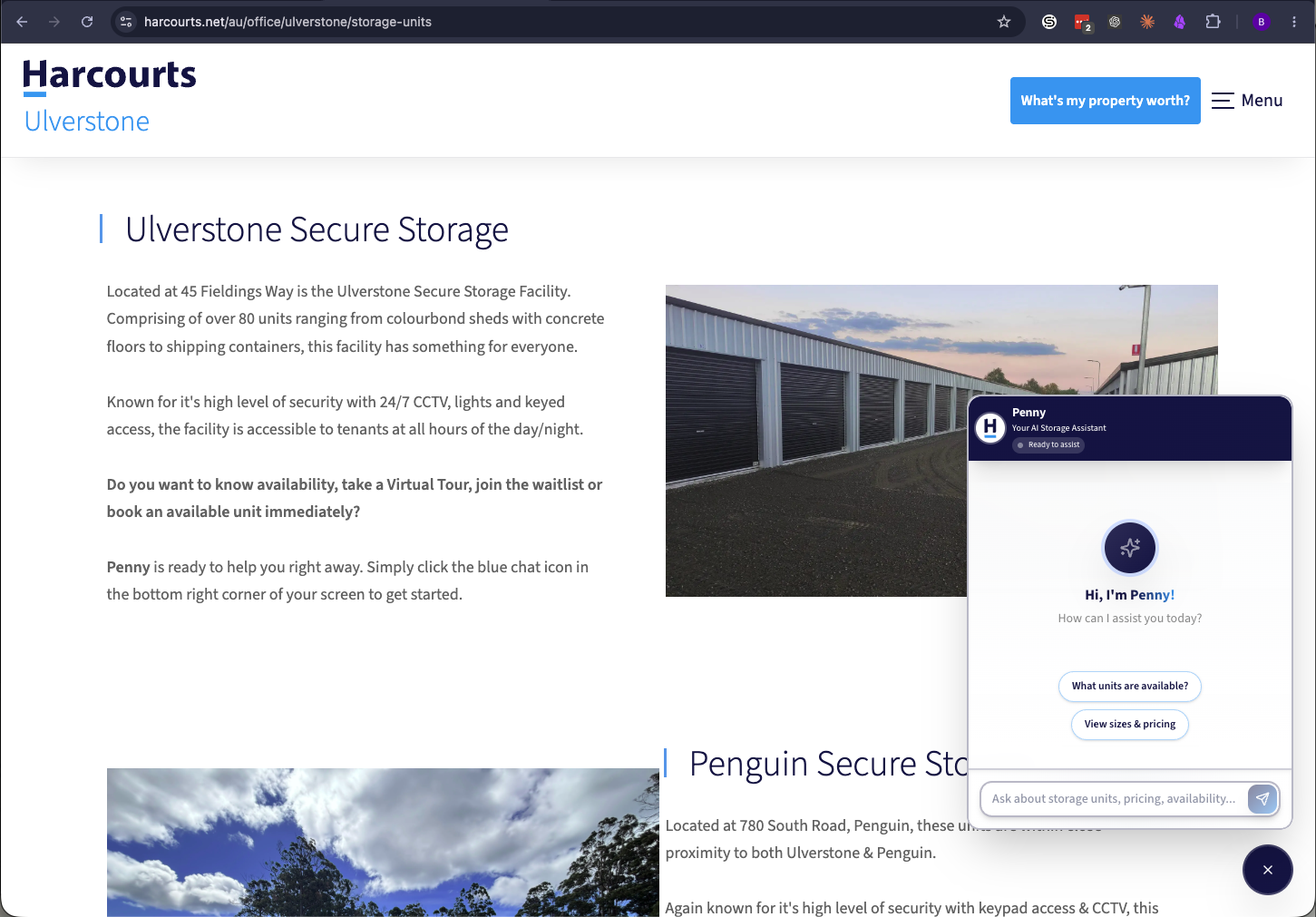
Ulverstone Secure Storage page with Penny, the AI storage assistant, live in the corner
7Facilities managed
24/7Calls answered

What began as our own tool is becoming a product. Penny is going to market to storage operators.

What we've built04 Sales

Offers and agreements, without the re-typing.

Sales admin is where agents lose their selling time. Structure the process once and it runs itself, so the agent stays in front of people.

Offer form

Link texted to the purchaser. All data captured the same way. Data compiled in the author dashboard, and vendor reporting easily completed.

Sole agency flow

The agreement process as a structured, guided flow, with all administrative steps completed up to booking photos. Same standard every time, whoever is running it.
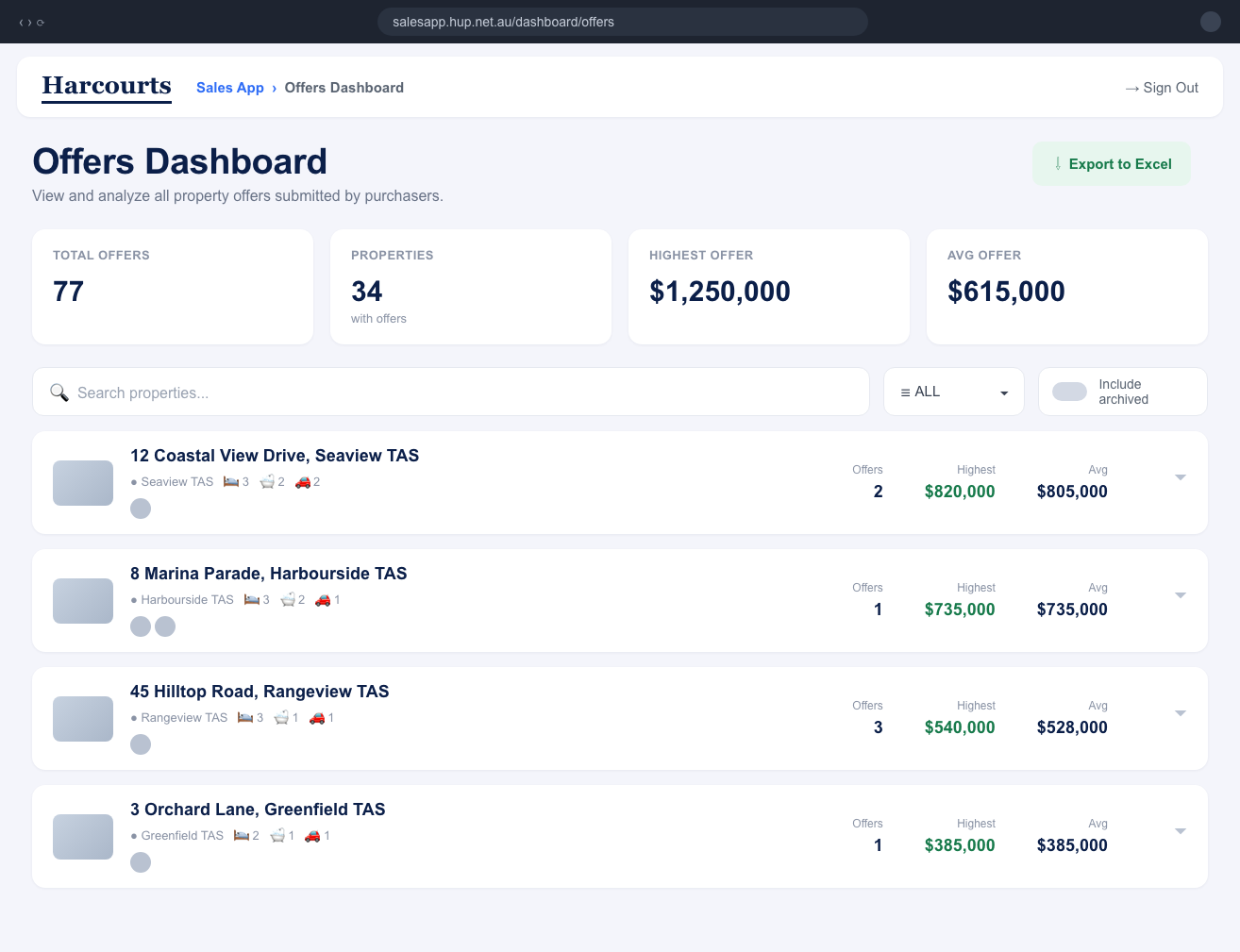
Harcourts Sales App Offers Dashboard: 77 offers across 34 properties
1Link for every buyer
0Manual re-keying
Where we are going

The roadmap.

Business

  • Finance. Payroll automation, AP, AR, bookkeeping.
  • EOS dashboards
  • After hours phone concierge

Sales

  • Automated contract drafting
  • Missing Millions process
  • Client nurture

Property management

  • Live dashboards
  • Finalise leasing process automation
  • Pitch tool for BDM and lease renewals
Part four
How to start.

You will not leave here building software. You will leave having spotted the one job in your agency worth handing over first.

What should I automate first?

Assess each task or process with these three questions.

One

A task that is repeated

Something you or your team do the same way, again and again.

Two

Rules based

How you would explain it to a new hire on their first day.

Three

Resource heavy (either time or cost)

It costs you real time, or real money, every time it is done.

Then prioritise

You will likely find a lot of tasks that qualify. Prioritise by resource load, and group tasks that share steps in the same process, where it makes synergistic sense to build them together.

How to break it downA worked example

Map the process, step by step.

Take a real job, paying the bills, and write down every step. The repeatable, rules based steps are the ones we hand to Claude. A person keeps the two decisions: whether to pay, and the final approval in the bank.

01

Bills to pay arrive by email, to an accounts address.

02

Those emails are forwarded straight into Xero.

03

Xero reads part of the bill. The rest is checked and added.

04 · human

Is the bill OK to pay?

05

If yes, create a batch payment and load it into the bank for approval.

06 · human

A human approves the payment in the bank.

A worked exampleNow hand it over

Two agents run it. You stay at the decisions.

Email agent · steps 1 to 2
  • Reads the inbox and sorts the bills from everything else.
  • Human in the loop. You review the list before it forwards to the accounts inbox.
Xero agent · steps 3 to 5
  • Reads each bill, and auto-approves the ones it can match, like a VPA against its invoice.
  • Human in the loop. Anything that does not match cleanly.
  • Builds the approved-payment batch and loads it into the bank on a read-only login, so it can prepare but never pay.
  • Human in the loop. You are notified to give final approval, by text, email or Teams.
Thank you

What will you automate first?

Brad Reevesbrad@brooklynbradley.com
ReevesBrooklyn Bradley, Harcourts Ulverstone & Penguin
1 / 16